
Introduction
A modern rig doesn't just drill a hole. It coordinates dozens of specialized tools working in constant sync, from the moment pipe is picked up to the moment mud circulates back to surface. A modern rig doesn't just drill a hole. It coordinates dozens of specialized tools working in constant sync, from the moment pipe is picked up to the moment mud circulates back to surface.
Today's rigs can reach depths greater than 12,000 meters and place horizontal wells more than 11,000 meters long with high precision.
That kind of precision depends on equipment quality. Yet many operators find that sourcing reliable, API-certified tools is often harder than understanding how the tools actually work.
This guide breaks down the essential tool categories on a rig, how they function as one interconnected system, what drives equipment costs, and how to vet a supplier you can actually trust.
Key Takeaways
- Drilling tools group into four functions: handling, drill string/cutting, circulation/solids control, and well control/safety
- A failure in one category (say, solids control) creates downtime or safety risk elsewhere on the rig
- Expect equipment costs to shift with rig type, material grade, and API certification
- Working with a distributor that vets API-certified manufacturers cuts sourcing risk
Essential Categories of Oilfield Drilling Tools
Grouping rig equipment by function, rather than listing it flat, shows how a rig actually runs. Each category handles a distinct job, and together they form the operational backbone of the entire drilling process.
Handling & Rigging Tools
Elevators, slips, tongs, and bails do the heavy lifting, literally. These tools grip and move drill pipe and casing every time the string trips in or out of the hole.
- Elevators clamp around the pipe body or tool joint to lift and lower it into the derrick
- Slips wedge into the rotary table to hold pipe weight while connections are made or broken
- Tongs apply torque to make up or break out threaded connections
- Bails connect elevators to the traveling block, transferring load through the hoisting system

Dropped objects remain a serious concern here. Industry safety reporting ranks them among the top 10 causes of injury and fatality in oil and gas. Corrosion, weak maintenance, and crew turnover during rig reactivations all raise the risk.
Sourcing quality matters in this category. Spicer & Sandburg represents PETOL GEARENCH, which has built oilfield handling tools under the PETOL and TITAN brands since 1927. That depth of design shows up in service: slips and tongs that wear predictably instead of failing without warning.
Drill String & Cutting Tools
The drill string transmits weight and torque from surface to the bit, while the bit does the actual rock-cutting work. Drill pipe makes up the bulk of the string's length. Drill collars add weight near the bottom to keep the bit engaged with the formation.
Bit selection depends heavily on rock type:
- PDC bits cut mainly by shear and typically need less weight on bit
- Tricone (roller-cone) bits crush and gouge, which suits harder or more variable formations
- Thermally stable PDC cutters hold up in harder rock where heat and wear climb fast
Formations suited to PDC drilling fail in shear rather than under roller-cone crushing and gouging.
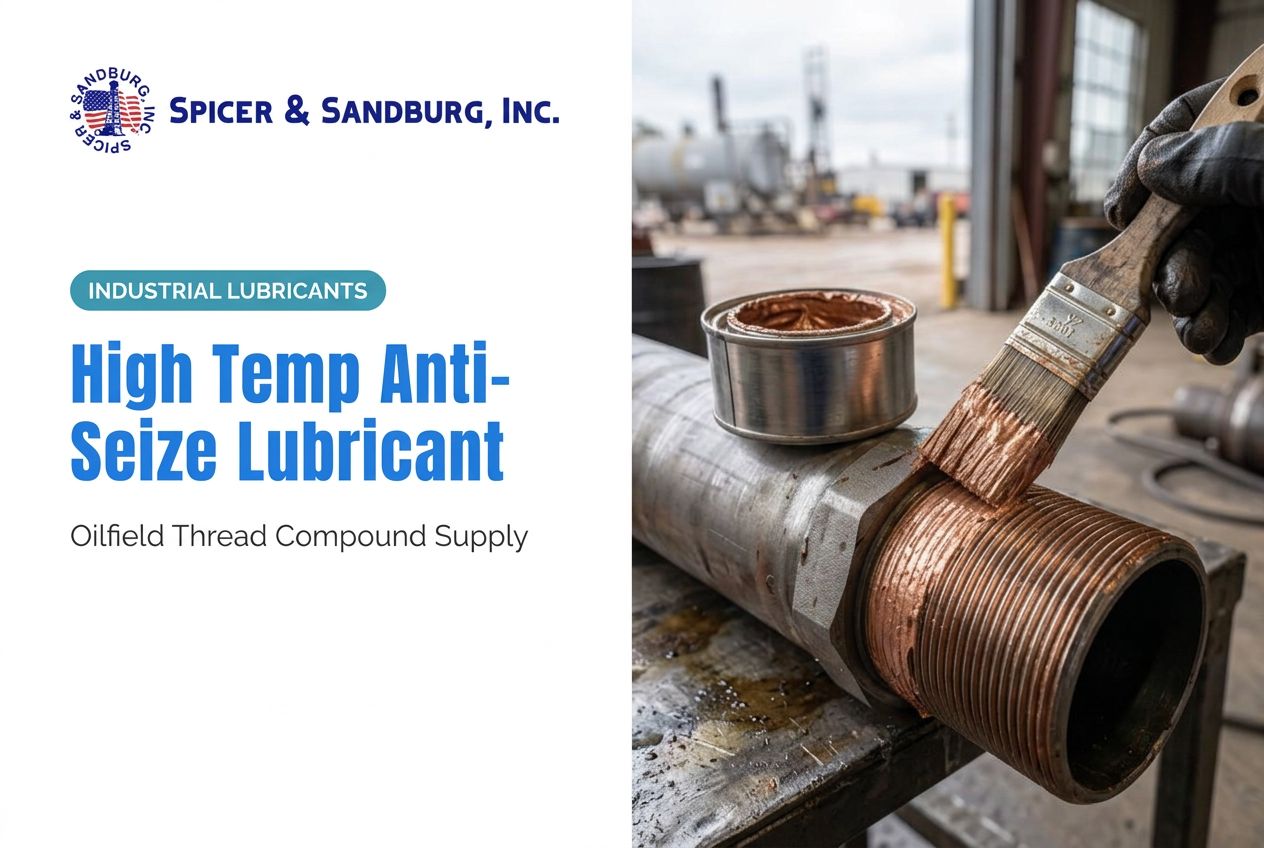
Connections matter as much as bit choice. Thread compounds such as BESTOLIFE—a Spicer & Sandburg partner with more than 80 years in petroleum—seal and lubricate drill-pipe and tubular threads. A poorly protected connection can gall or leak long before the bit wears out.
Circulation & Solids Control Equipment
Mud pumps push drilling fluid down the string and back up the annulus, carrying rock cuttings to surface. From there, shale shakers, degassers, and mud cleaners strip out solids and gas before the fluid recirculates.
Automation is changing this category fast:
- Modern shakers auto-adjust deck angle and switch linear/elliptical motion as conditions change
- Current-generation high-capacity shakers deliver 20–30% higher capacity than comparable single-deck units, including full flow at 700 gpm on one shaker
- Real-time monitoring samples rheology, density, and pressure about every 10 minutes—flagging issues like barite sag in ~30 minutes versus ~six hours with manual checks
Pressure monitoring underpins all of this. PIC Gauges, distributed through Spicer & Sandburg, supplies pressure gauges and diaphragm-seal instrumentation built for upstream drilling and process applications, giving crews the readings they need to catch problems before they escalate.
Well Control & Safety Tools
The blowout preventer (BOP) is the last line of defense against a well control event. Stabbing guides and safety clamps also protect pipe connections and crew during makeup and breakout.
The stakes are documented. Regulatory reporting recorded five loss-of-well-control events on the US Outer Continental Shelf in 2023—0.212 incidents per million work hours across drilling and well operations. Keeping that rate low depends on well control gear that is engineered, tested, and inspected to strict standards.
How These Tools Work Together During the Drilling Process
None of these categories operates in isolation. A typical drilling sequence looks something like this:
- Rig power-up — surface systems, mud pumps, and rotary equipment come online
- Bit engagement — the drill string rotates, and weight is applied to begin cutting rock
- Mud circulation — fluid carries cuttings up and through solids control equipment
- Tripping pipe — handling tools raise or lower the string as bits or assemblies are changed
- Continuous well control monitoring — the BOP stack and pressure instrumentation stay active throughout

The interdependency is the part operators sometimes underestimate. Poor solids control sends abrasive cuttings back downhole, which shortens pump and bit life. A worn set of slips slows tripping and leaves the well longer without full circulation.
One weak link can stall the entire operation. That is why equipment quality matters in every category—not only the ones that look most critical at first glance.
Routine tool inspection between stages keeps this workflow moving. A quick check of slip dies or tong jaws before the next connection is far cheaper than an unplanned stoppage mid-trip.
This coordination also shifts by rig type:
- Land rigs run a straightforward core loop with surface equipment only
- Jackups stay bottom-supported and fixed once positioned
- Semisubmersibles can reposition through kedging—about 100 to 150 meters per move, based on reported Norwegian Continental Shelf unit data
- Floating semis and drillships add marine riser and subsea well control on top of the standard loop
That added complexity is why floating units are covered by a separate standard equipment list.
What Affects the Cost of Oilfield Drilling Equipment
Equipment costs vary widely, and three factors explain most of that spread.
Rig type drives scale and complexity. Industry cost analysis put rig costs at more than 50% of total offshore drilling and completion costs in 2024, with OCTG (oil country tubular goods) representing roughly another 13% of the total. Land rigs generally involve less engineering complexity and lower day rates than offshore or mobile units.
Material grade and API certification add cost, but also add assurance. Certified components undergo more rigorous testing before they ever reach a rig floor. Crossover Inc. and Mayco Inc., both Spicer & Sandburg partners, manufacture EUE pup joints and tubing couplings to API Spec 5CT and API Spec 7. They produce under an API-approved quality assurance program with the API Monogram. That level of documentation matters when a failure downhole isn't an option.
New, used, or rental equipment changes the capital picture. Buying new gives full control over maintenance history and specification. Used or rental equipment can lower upfront costs but shifts risk onto inspection quality and remaining service life. There's no universal price break-even point. It comes down to project duration, expected utilization, and how well-documented the equipment's maintenance and certification history actually is.
Before buying anything with an API mark on it, confirm that the manufacturer's API license and facility status are still active.
Choosing a Reliable Oilfield Tools Supplier
Sourcing drilling, completion, and production equipment from a single distributor with a broad manufacturer network cuts procurement complexity dramatically. Instead of chasing down a dozen vendors, one relationship covers most of what a drilling program needs.
API-certified manufacturer partners should be the baseline, not a bonus. When a supplier vets its manufacturers for certification, quality systems, and consistent track records, that diligence is built into what you receive.
Spicer & Sandburg operates on this model. The family-owned distributor connects oil and gas professionals with a curated network of manufacturer partners rather than making products in-house. That network includes:
- PETOL GEARENCH (since 1927) — oilfield handling and rigging tools
- BESTOLIFE (80+ years) — thread compounds for drilling, completion, and production
- Hy-Lok USA (40+ years) — instrumentation tube fittings and valves
- Mayco and Crossover — API-certified OCTG, pup joints, and tubing couplings
- PIC Gauges — pressure and temperature instrumentation
- Tnemec and Seymour Paint — protective coatings and corrosion resistance
- Tripak Superlubricants — industrial and drilling lubricants

The value isn't just the number of partners. It's that each one brings decades of specialization to a specific piece of the drilling puzzle, so you hit fewer sourcing gaps and fewer surprises when equipment reaches the location.
Maintenance and Safety Best Practices for Drilling Tools
Even the best equipment fails without a maintenance routine behind it. API standards cover inspection and remanufacture for components like slips, elevators, and rotary spiders. Spec 7K applies to drilling and well-servicing equipment; RP 8B covers hoisting equipment.
Three practices keep tools running and crews safe:
- Follow routine inspection schedules for high-wear parts such as slips, tongs, and cutting inserts, using API standards, OEM guidance, and service severity
- Train crews thoroughly on proper handling—personnel turnover and rushed connections drive many dropped-object incidents
- Track wear parts proactively, including dies, inserts, and safety clamps, so replacements happen on schedule instead of during unplanned stoppages
None of this is glamorous work. But a rig that inspects its handling tools every trip and replaces worn dies before they fail spends far less time waiting on parts than one that doesn't.
Frequently Asked Questions
What equipment is used for oil drilling?
A drilling rig relies on power and rotary systems, drill string and bits, circulation and solids control equipment, hoisting and handling tools, and well control and safety equipment. Together they cut rock, move drilling fluid, and keep the wellbore under control.
How much does oil drilling equipment typically cost?
Costs depend heavily on rig type, material grade, API certification level, and whether equipment is new, used, or rented. Offshore equipment generally costs more than land rig equipment due to added engineering and pressure requirements.
What are the most important handling tools on a drilling rig?
Elevators, slips, and tongs form the core of pipe-handling equipment. Elevators lift and lower pipe, slips hold it in the rotary table, and tongs make or break threaded connections safely.
How often should oilfield drilling tools be inspected?
Inspection intervals should follow API guidance (such as Spec 7K and RP 8B), OEM recommendations, and actual usage intensity. High-wear components like slips and tongs typically need more frequent checks than lower-wear equipment.
What's the difference between drilling tools and production tools?
Drilling tools create the wellbore, covering everything from bits to hoisting equipment. Production tools, such as tubing anchors and pumps, manage the ongoing extraction of oil and gas once the well is complete.
Do I need different tools for offshore vs. land drilling?
Yes. Offshore rigs require additional pressure-rated, corrosion-resistant equipment along with marine-specific systems like riser handling, that land rigs don't require.